


For a person, creativity is one of the opportunities to penetrate into his inner world and recognize himself. It appeals to the best aspects of our soul, to the brightest, richest and most sincere. When a person writes, paints, sculpts from clay or expresses himself in other forms of art, it allows him to relax, open up and, at least for a while, find himself in harmony – harmony with himself. In addition, creativity is an effective method of treating the psyche, which today is widely used in practical psychology under the name of art therapy.
As a method of psychological help, art therapy has existed for a long time. It is known that in ancient China, the healing of nervous shocks was practiced by drawing hieroglyphs. The term “art therapy” was first used by the artist Adrian Hill in the late 1830s, describing his experience of treating tuberculosis patients, during which he realized that the creative process helped his patients overcome the disease. The development of art therapy as a full-fledged direction in psychology began much later – from the 30s of the 20th century, when art therapy methods were used to help children taken from Nazi concentration camps during the Second World War. Initially, art therapy was based on the psychology of Sigmund Freud and Carl Gustav Jung, according to which the result of a person’s creative activity reflects his unconscious and the processes that take place in it. In 1960, the American Art Therapy Association began its work in the USA.
What is art therapy?
The term art therapy is formed from the English words art – “art, skill” and therapy – “treatment, therapy” and is literally understood as art therapy.
Art therapy is a psychotherapeutic method based on the creative self-expression of an individual and aimed at healing the psyche, self-discovery and self-actualization. This approach is effectively used to treat depression and nervousness, fears and phobias, as well as to remove internal blocks and clamps. The most impressive results that can be seen immediately, art therapy can be obtained during times of great stress – perhaps in this case there is no equal among other psychotherapeutic approaches.
At the same time, art therapy is a universal method that is not necessarily used only when a person has problems. Each of us needs self-actualization no less than food or sleep. Art therapy allows us to bring this need to the level of consciousness, thanks to which we can express ourselves in this world more fully and brightly.
One of the main advantages of art therapy is that healing, development of one’s own potential and acquisition of inner harmony is available to everyone – this method does not require special training, skills and talents. On the contrary, they can be disruptive because they set standards. Therefore, if a person was previously engaged in some kind of art, he is offered to forget everything he knows for a while, or to use another type of creativity for work. Spontaneity is important here, which allows a person to express himself, understand his feelings, learn to trust, be open and act with complete freedom.
People who are not familiar with art therapy before, ask themselves a logical question: “What makes it different from ordinary classes in painting, music or theater?”. The difference here is that for the participants of art therapy groups, art is not an end in itself, but only a means that allows you to look into your inner world. Classes here are not aimed at the result, but at the process, while during special training, for example, painting, all efforts are made towards creating the most perfect work of art. The goal of art therapy is primarily to help people learn to express their emotions, and the works they create in the process have only a supporting value and are used to understand the experiences that resulted from them.
“I would like to draw as children do – for them there are no laws and proportions, so their drawings are full of expression and life…” Pablo Picasso
A drawing, a sculpture or a written text provides the psychologist with rich material for analysis, based on which he can help the client. However, it is much better that the work is analyzed, first of all, by the author himself, because art therapy belongs to insight-oriented methods, that is, it is aimed at experiencing insight. Analyzing or simply contemplating his work, a person independently comes to understand the problem or himself, which brings many times greater effect than if it was said by a psychotherapist. Moreover, who better than us is able to understand our inner world, if not ourselves? Understanding does not necessarily come immediately after the work is done, but it always comes. You should put your work aside and sometimes return to it, looking at it in different moods and from different angles.
As already mentioned, art therapy is based on the discoveries of psychoanalysis, according to which creativity reflects the processes occurring in a person’s subconscious. One of the key concepts in art therapy is sublimation and transformationtion, which mean that all internal emotions during therapy are not suppressed, are not pushed into the subconscious, but are transformed into expressive images. Creativity is a peculiar language of symbols, understanding which you can learn to see and understand your fears, secret desires, unfulfilled dreams and internal conflicts. Through form and color, inner experiences are released much more easily and naturally than with verbal communication. By bringing them to the surface and re-experiencing them, we get rid of what we don’t need.
For example, someone offended you a lot and you wanted to say something back or even hit that person, but restrained yourself. Maybe this person was your boss, maybe they were just stronger than you. The situation will remain unresolved and if it does not find a way out, it will go into the unconscious, become a painful wound that will negatively affect your entire future life. People usually look for someone else to vent their anger on. Art therapy allows you to express all this in symbolic images and free yourself from unnecessary burden. It becomes a catharsis through creativity. The beauty of art therapy is that it provides an opportunity to express any situations that traumatize the psyche: misunderstanding of loved ones, betrayal, resentment, anger, loss of trust, etc. When all this comes to the surface, and the causes of internal conflicts become understood, the problem simply dissolves by itself, and life again becomes cloudless, filled with joy and satisfaction.
The advantages of art therapy are that it:
- is suitable for almost all people, regardless of their age and does not require special creative skills and abilities;
- is mainly a means of non-verbal communication, which provides direct access to the subconscious;
- allows you to express negative emotions in a socially acceptable manner and without harming others;
- contributes to the rapprochement of people and the establishment of harmonious relations, which is very valuable in case of mutual antipathy and difficulties in establishing contact;
- provides volume material for further analysis;
- is a means of free self-expression, takes place in a warm atmosphere of trust, evokes positive emotions in people and helps in forming an optimistic life position.
Types of art therapy
Isotherapy
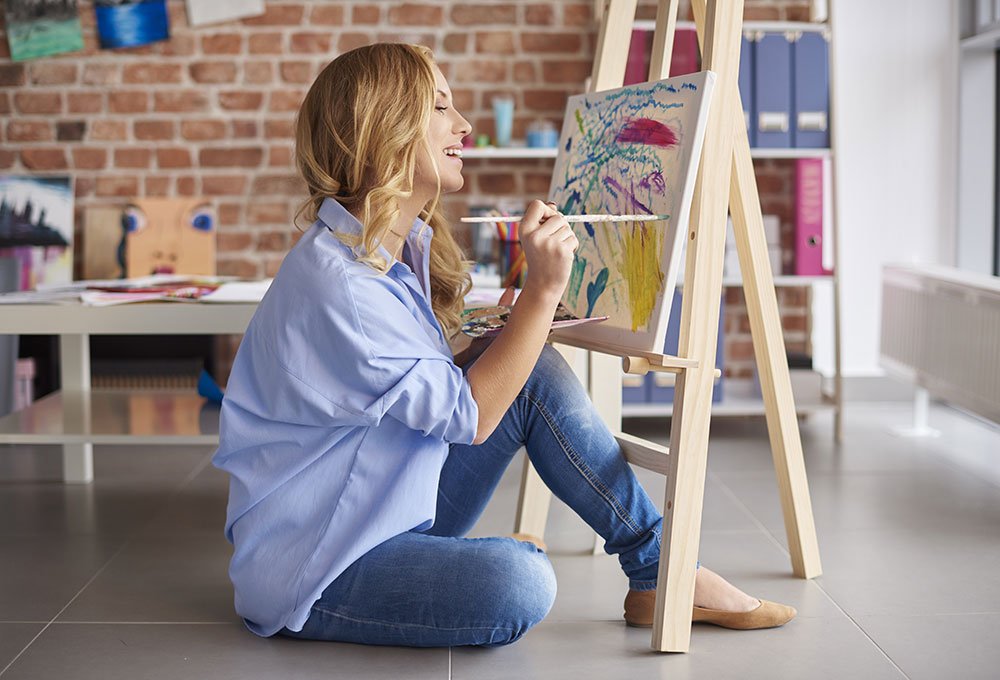
Painting and other applied arts are one of the most common types of art therapy. Isotherapists recommend expressing your emotions and experiences with the maximum possible spontaneity. The main advantage of isotherapy is that it removes the barrier of self-censorship, opening the door to our subconscious. Creative activity has the unique property of bringing to the surface everything hidden and unconscious, which constantly puts pressure on us and prevents us from breathing freely. When drawing or sculpting, the right hemisphere of the brain is involved, which allows you to bypass the censorship of the mind, which tries to filter negative thoughts and emotions, as well as everything related to deep unconscious processes. But before choosing a color scheme, before the images that arise, our mind becomes simply powerless. Along with this, isotherapy often uses a technique for reflecting one’s own dreams and the method of drawing mandalas, which is also successfully used in holotropic therapy developed by Stanislav Grof.
Dance therapy
What could be more beautiful than expressing your feelings and emotions in dance? Along with this, dance therapy classes are so effective and healing that they can change your views on the world – for this you only need to make dance your ally. Wilhelm Reich, the founder of body-oriented therapy, said that if emotions (any: anger, resentment, joy, enthusiasm) are not given an outlet for a long time, they accumulate in the cells of our body, forming a kind of muscular shell. Dance therapy helps to prevent this, and if it already exists, to break it. To dance until the moment when the feeling of freedom does not appear. Classes in a dance studio in this case will not be suitable simply because all movements there are determined by the teacher, and not expressed spontaneously.
Music therapy
“Music is a revelation higher than wisdom and any philosophy,” said Beethoven. Numerous studies conducted in the west allow us to conclude that music therapy brings great benefits. It is effectively used for Alzheimer’s disease, depression, stress and insomnia. When listening to music, a person’s inner state changes – he adjusts to the rhythm of the melody, absorbing positive vibrations. So classical and meditative music not only helps to raise the mood and relax, but also has a significant therapeutic effect.
Play therapy
Participation in stage productions also has a healing effect on our psyche. Acting out difficult situations from life, turning to the secret corners of our psyche in search of important emotions, wewe break access to the subconscious. In addition, memory, attention, will, feelings, imagination and the ability to own one’s own body are activated during the theater game. A variant of this type of art therapy is sand therapy, the foundations of which were laid by K. Jung. It should be noted here that there is a whole direction in psychology that uses role playing as therapy called psychodrama, the founder of which is Jacob Moreno.
Phototherapy
Photography is used to solve psychological problems, personal growth and self-discovery. This is a relatively new type of art therapy, the development of which began in the 70s of the last century in America. Here a person can take photos, pose or work with ready-made photos. All this is combined with discussion and other types of creativity. Additional visual techniques are used, such as drawing, collage, installation of prepared pictures in the interior, creation of layouts from photographs and further interaction with them, artistic description, games, dance, etc.
Story therapy
This type of therapy is very suitable for dreamers. It is successfully used to understand the state of the psyche, resolve conflict situations, and even internal changes. Of course, fairy-tale therapy is an indispensable method for helping a child – children can either listen to a fairy tale told by a therapist or invent their own stories. Creating a plot independently, the child reveals his inner world, talks about what he feels and dreams about, learns to find a way out of difficult situations.
How art therapy works
A person can undergo an art therapy session in a group, in individual work with a psychotherapist, and also independently.
In the case of group art therapy, its participants, in the number of 10-15 people, who are ready to experiment, develop and learn about themselves, gather together, and the therapist offers one of the types of creativity. Each of them, be it painting, sculpting, dance, drama or poetry, is a means that helps a person to open up, to see his unrealized dreams and unrealized talents. Many of us always wanted to do something other than what we are doing now. But upbringing and society leave their mark, and very often it turns out that we are doing something we don’t like. Art therapy allows people to see in their work a reflection of their true nature and understand who they really are.
At first, an art therapy session is like playing art. It is a space for experimentation, trial and error, there is no right or wrong, beautiful or ugly. In such moments, everything has value, no matter what happens. Each member of the group expresses himself in creativity as he can and as he wants. The sooner he manages to relax, open up, stop worrying about the opinions of others, the sooner he will feel that playing art has become art itself, that what he creates is truly unique, beautiful and valuable. From session to session, trust, attentiveness, cooperation, creativity and, finally, spontaneity are manifested and developed in the groups.
At the final stage in group art therapy, a stage of verbal communication is provided, during which you can discuss everything that is happening, interpret the products of creativity and the associations that have arisen.
Thus, art therapy techniques give us the opportunity to create our own life in the literal sense of the word: paint sadness, sculpt happiness, write about difficulties and dance moods.
Everyone can realize their inner potential and, as a result, find themselves in harmony with themselves and the world around them, and no special training is required for this. One of the main principles of art therapy shows that creativity is healing in itself, it not only allows us to live again and resolve internal conflicts, but also enriches our soul. Art therapy provides us with a wonderful opportunity for this – here we can express ourselves, find healing and realize our inner potential.